Part 1 - A Brief History
Shotokan Karate: A Brief History
Part 1 - Shotokan Karate: A Brief History
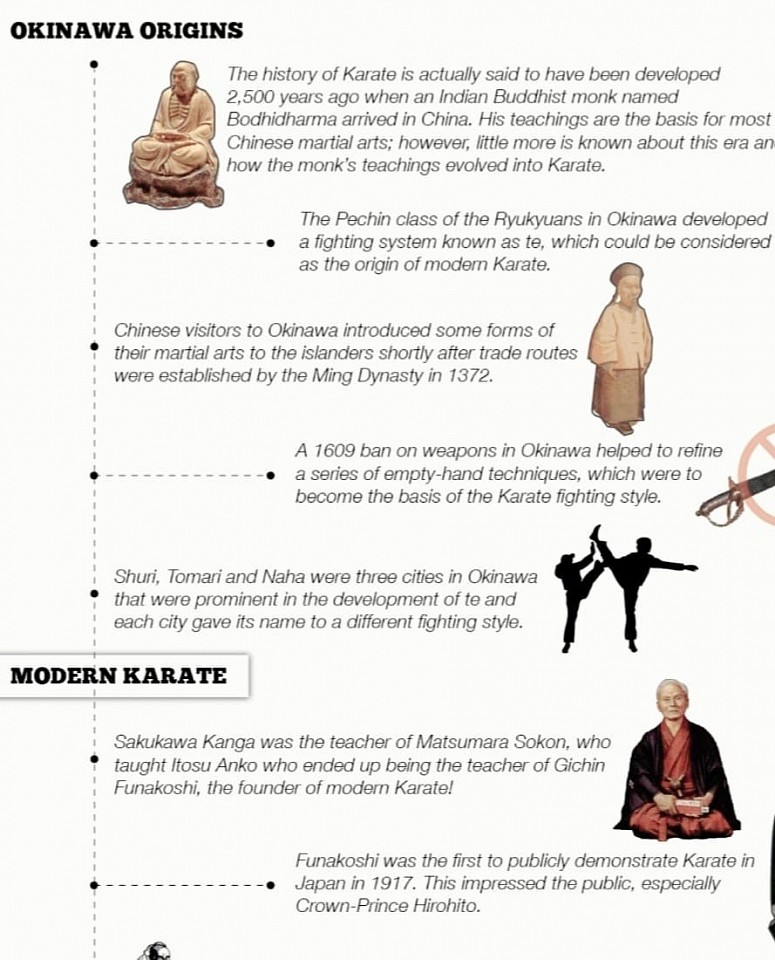
The story of Shotokan Karate is a near-2000 year evolution from secretive warrior-monks to a global "Way" of life. Its roots lie in the ancient Chinese martial arts, to the Ryukyu Kingdom (modern-day Okinawa), where indigenous fighting methods known as Te blended with Chinese Kung Fu brought by masters like Kushanku and Kanga Sakugawa.
By the 19th century, this art was refined by the "Royal Architect" Sokon Matsumura, who served as the bodyguard to Okinawan kings. His students - the legendary Anko Itosu and Anko Azato - transformed these lethal techniques into an educational system for the public, passing their knowledge to a young schoolteacher named Gichin Funakoshi.
In 1922, Funakoshi brought this "Empty Hand" (Kara-te) to mainland Japan. He modernized the art by introducing the white uniform, the belt ranking system, and the Niju Kun (ethical code), ensuring that the "perfection of character" remained the ultimate goal. The style was eventually named Shotokan - after Funakoshi’s poetic pen name, Shoto (waving pines) and Kan (hall).
The physical power seen in modern Shotokan was largely developed by Gichin’s son, Yoshitaka (Gigo) Funakoshi, who introduced the deep stances and explosive kicks that define the style today. Following World War II, the Japan Karate Association (JKA) standardized these teachings, sending elite instructors across the globe to share the "Three K's": Kihon (Basics), Kata (Forms), and Kumite (Sparring).
Today, Shotokan is the most widely practiced karate style in the world - a living legacy of resilience, discipline, and the pursuit of excellence.
As Karate moved from Okinawa to mainland Japan in the early 20th century, three distinct schools emerged, each shaped by different masters and interpretations of earlier traditions.
- Gojo-ryu
- Shito-ryu
- Wado-ryu
Although it developed later, a fourth school, Kyokushin is also prominently regarded. More detail on these schools is in Part 2 - In Depth History.
Meet the Masters: The Shotokan Lineage
· Kushanku (1700s): The Chinese military attaché who brought quanfa to Okinawa and inspired the foundational Kanku Dai kata.
· Kanga "Tode" Sakugawa (1733–1815): The first Okinawan to master Chinese techniques and introduce the ethical Dojo Kun to martial arts.
· Sokon "Bushi" Matsumura (1809–1899): The legendary royal bodyguard who synthesized Okinawan Te with Japanese swordsmanship to create the Shuri-te system.
· Anko Itosu (1831–1915): The "Grandfather of Modern Karate" who created the Heian katas and brought karate into the public school system.
· Anko Azato (1827–1906): A scholar-warrior and master tactician who served as the primary technical mentor to Gichin Funakoshi.
· Gichin Funakoshi (1868–1957): The "Father of Modern Karate" who brought the art to mainland Japan and established it as a philosophical "Way" of life. His “20 Precepts of Karate” is a foundational text for the practice and philosophy of karate.
· Yoshitaka (Gigo) Funakoshi (1906–1945): The third son of Funakoshi, he was the technical innovator who introduced the deep stances and explosive kicks that define the modern Shotokan look.
· Shotokai (松濤會): The Traditionalist Guard
Shotokai is the organization dedicated to preserving the founder's original vision of karate as a non-competitive, spiritual "Way" to uphold the essence of karate’s focus on self-perfection and the harmony of mind and body.